Nova Scotia Radon Map: Red & Green Flags | Radon Atlantic
Nova Scotia Radon Map: Red Flags vs. Green Flags for Homeowners
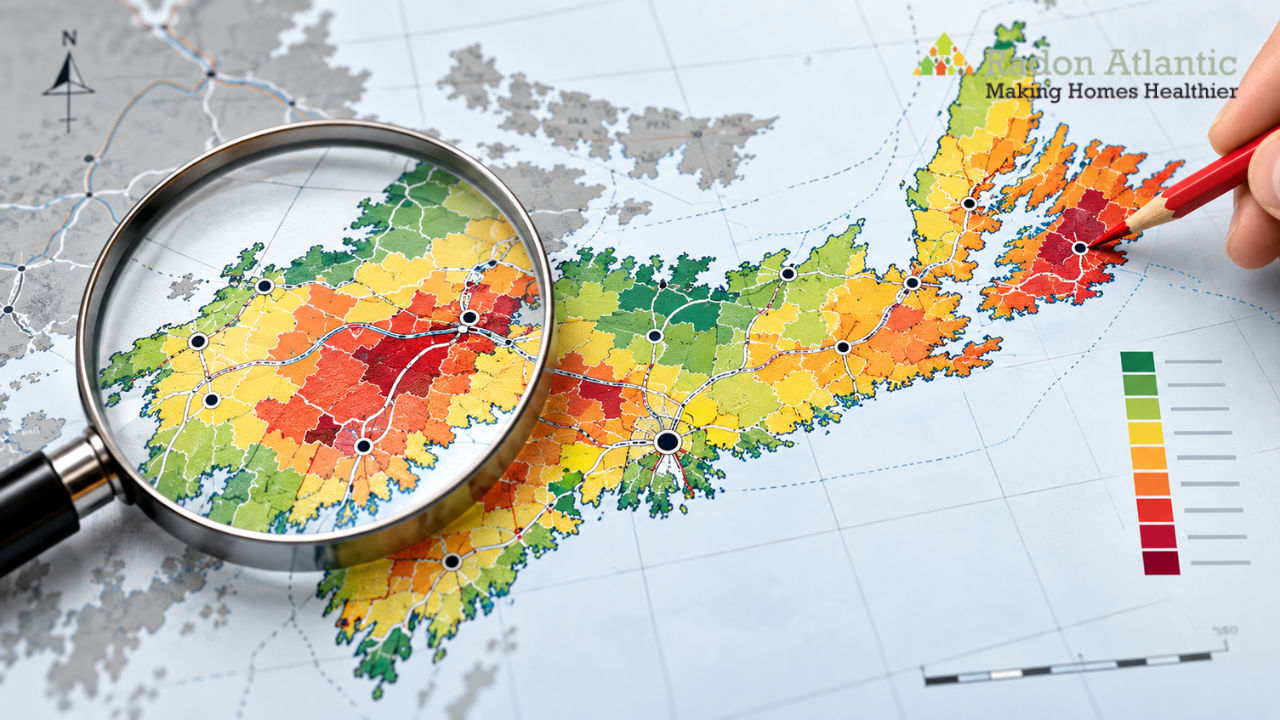
You check the map, find your community, and see a lower-risk category. Does that mean you can cross radon testing off your list? Not necessarily. The Nova Scotia radon map is useful for understanding regional radon potential, but it cannot tell you the radon concentration inside your individual home. Knowing how to interpret the information can help you decide what to do next.
? Red Flag: Assuming a Lower-Risk Area Means Low Radon
A lower-risk area may seem reassuring, but it does not guarantee that every home in that area has a low radon concentration.
Nova Scotia’s radon data shows that elevated readings can occur across different mapped risk categories. In other words, geographic information can indicate potential, but individual homes can still produce different test results.
? Green Flag: Use the Map for Context
Think of the map as a starting point rather than a test result.
It can help you understand the broader conditions around your community and why radon testing may be worth considering. The actual concentration inside your home can only be determined through appropriate testing.
? Red Flag: Comparing Your Home With Your Neighbour’s
A neighbour’s radon result may seem like a useful reference, particularly when the homes are close together.
However, properties can differ in foundation design, soil conditions, openings around pipes and utility services, ventilation, and other characteristics that influence how radon enters and accumulates indoors.
? Green Flag: Pay Attention to Your Own Test Result
The most relevant measurement is the one taken inside your property.
Long-term radon testing for at least three months can provide a more representative picture of typical indoor radon exposure, since concentrations can vary over time.
? Red Flag: Treating the Map Like an Individual Reading
A map can show where radon potential may be greater across a region. It cannot tell you whether your home has 50 Bq/m³, 200 Bq/m³, or a substantially higher concentration.
This distinction is important when interpreting any regional radon information.
? Green Flag: Turn Regional Information Into a Measurement
The Nova Scotia radon map can provide useful background information. A radon test provides property-specific information.
That makes testing the logical next step for homeowners who want to know what is actually happening inside their home rather than relying on a regional estimate.
The Number That Matters
Radon is measured in becquerels per cubic metre (Bq/m³). The Canadian guideline for indoor radon is 200 Bq/m³. When the annual average concentration is above this level, action to reduce radon exposure is recommended.
The important point is that the number comes from testing—not from the colour or category shown on a regional map.
? Red Flag: Looking for Visible Signs of Radon
Radon is different from many household problems because there may be nothing obvious to see, smell, or taste.
A clean, well-maintained basement does not necessarily indicate a low radon concentration. Likewise, visible foundation issues do not provide a reliable measurement of indoor radon.
? Green Flag: Make Testing Part of Home Maintenance
Testing can give homeowners information that cannot be obtained through a visual inspection.
For a long-term test, the detector should generally be placed in the lowest lived-in level of the home where someone spends more than four hours per day. Following the manufacturer’s instructions is also important for obtaining a useful result.
? Red Flag: Assuming an Elevated Result Has No Practical Solution
Receiving an elevated result can raise questions about what happens next. It does not mean that homeowners are out of options.
Radon levels can often be reduced through mitigation measures selected according to the building and how radon is entering it.
? Green Flag: Get the Property Assessed
If testing identifies elevated radon, the next step is to understand the appropriate mitigation options for the specific property.
Potential approaches can include active soil depressurization and other measures intended to reduce radon entry or concentration. The right approach depends on factors such as the home’s foundation and construction.
From Map to Action
The Nova Scotia radon map is most useful when viewed as one part of a larger process:
Check the map ? Understand the regional potential ? Test your home ? Review the result ? Consider appropriate action
That approach avoids two common mistakes: assuming that a higher-risk area automatically means your home has elevated radon, or assuming that a lower-risk area means testing is unnecessary.
For homeowners who want help understanding radon testing or what to consider after receiving an elevated result, Radon Atlantic can provide information about testing and mitigation services available for properties in Nova Scotia.